Mycotoxin prevalence in European and Latin American corn in 2025

Mycotoxins remain one of the most widespread and underestimated risks to global feed safety. Produced by fungi such as Fusarium, Aspergillus, and Penicillium, these secondary metabolites contaminate cereals and raw materials at every stage of the value chain.
Among them, fusariotoxins like deoxynivalenol (DON), zearalenone (ZEA), and fumonisins (FUM) continue to dominate in both prevalence and average level. Their effects range from reduced animal performance and immune suppression to reproductive disorders and increased susceptibility to disease.
In 2025, the global mycotoxin landscape was shaped by climate variability and increasing pressure on raw material supply chains. Warmer temperatures, irregular rainfall, and extreme weather events have expanded the ecological niche of Fusarium species, particularly in corn-producing regions. As a result, both Latin America (LATAM) and Europe face sustained exposure to mycotoxins, although with different contamination profiles, drivers, and risk patterns.
LATAM: high prevalence and polycontamination pressure
Data from 2025 confirms that LATAM remains a hotspot for fusariotoxin contamination, driven by climatic conditions favourable to fungal growth, intensive corn production, and frequent challenges in post-harvest management.
Across the region the level of general contamination (samples with at least 1 mycotoxin) was 83%. Regarding individual mycotoxins, FUM show the highest prevalence of tested samples (69%), followed by DON (30%) and ZEA (34%).
In terms of contamination levels, FUM average was 1,760 ppb, DON 357 ppb and ZEA 74 ppb. This consistent polycontamination significantly increases toxicological risk, as synergistic effects are increasingly recognised in animal production, especially between DON and FUM.
 There is a downward trend in Aflatoxin (AFLA) contamination over recent decades, but 17% of the samples remain contaminated with this mycotoxin, at a level of 9 ppb.
Brazil continues to set the regional pattern. As one of the world’s largest corn producers and exporters, the country shows a contamination profile dominated by FUM (68% of positive samples, with an average of 1,654 ppb). DON and ZEA are also widely present, reflecting the strong influence of Fusarium graminearum and F. verticillioides across multiple growing regions.
DON was present in 30% of samples, with an average contamination of 350 ppb, and ZEA was present in 33% of the samples with an average of 72 ppb.
In Argentina, 2025 data indicates a higher prevalence of FUM and ZEA compared with the LATAM average. FUM prevalence was 75% with a mean concentration of 1,739 ppb. ZEA prevalence was 40% with a mean of 56 ppb. Regarding AFLA, the prevalence was higher than in the LATAM region (30%), with a higher mean 12 ppb, reflecting the potential for improvement in Argentine corn storage.
Colombia presents a concerning scenario. Tropical conditions, combined with storage and logistics constraints, result in high FUM prevalence (100%) and contamination mean (3,004 ppb), combined with high DON prevalence (88%). Peru is characterised by a predominant FUM prevalence (80%) with a mean contamination of 4,711 ppb. ZEA is also a threat in Peru with a prevalence of 53% with a mean of 147 ppb. DON and AFLA contamination were quite similar to the average in the LATAM region.
Overall, LATAM in 2025 is characterised by high prevalence, frequent polycontamination, and biologically relevant concentrations, making fusariotoxins a structural rather than incidental problem for the region.
Europe: high frequency, and climate-driven shifts
In contrast to LATAM, Europe traditionally exhibits lower average mycotoxin concentrations, but 2025 data confirms that prevalence (particularly of fusariotoxins) remains high and, in some areas, is increasing.
DON is the most widespread (88%) mycotoxin across European cereals, followed by ZEA (79%), reflecting the dominance of Fusarium graminearum in corn systems. The risk profile is less related to acute contamination events and more to chronic exposure through highly contaminated batches entering compound feed. FUM prevalence was 73% of positive samples with a mean concentration of 583 ppb.
In France, one of Europe’s largest cereal producers, DON continues to be detected in a significant proportion of samples (95%) with a mean of 1,100 ppb. The 2025 season reinforces the link between humid flowering periods and DON prevalence. ZEA is frequently co-contaminating corn together with DON. ZEA prevalence was 88% and the mean value was 139 ppb. Although FUM are less prevalent than in LATAM, their presence in corn-based feeds remains non-negligible. Prevalence was 72%.
Spain illustrates the growing impact of climate variability in southern Europe. Traditionally associated with AFLA risk during hot, dry seasons, Spain is now experiencing increased Fusarium toxin pressure, particularly in irrigated corn systems.
DON and FUM are increasingly overlapping, creating synergistic risk profiles. DON prevalence was 62%, with an average of 1,300 ppb. ZEA also had a high prevalence (72% of positive samples), demonstrating that F. graminearum is widespread in Spanish agricultural systems. FUM had a lower prevalence, but with a relatively high average level (2,000 ppb).
Across Europe, the key message from 2025 is clear: fusariotoxins are no longer confined to specific regions or seasons. Climate change is flattening traditional risk maps, and low-dose, long-term exposure is becoming the dominant concern for animal health and performance.
Take-home message: From prevalence to proactive management
The 2025 contamination data from LATAM and Europe highlight a common reality: mycotoxins, and fusariotoxins in particular, are a permanent feature of modern feed systems. While LATAM faces higher prevalence and concentrations (especially of FUM), Europe contends with widespread DON and ZEA exposure driven by changing climatic conditions. In both regions, polycontamination is the rule rather than the exception.
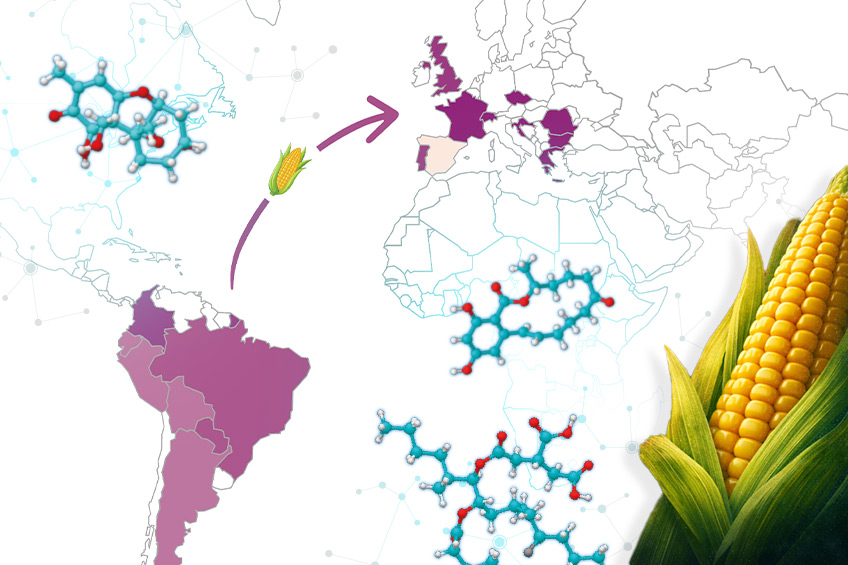
Beyond regional implications, the relevance of LATAM in the global mycotoxin discussion is amplified by its role as one of the major corn-exporting regions. Countries such as Brazil and Argentina collectively supply a significant share of corn used in animal feed worldwide, particularly to Europe, Asia, and the Middle East. As a result, fusariotoxin contamination originating in LATAM does not remain a local issue, but travels across borders through international trade. Mycotoxin risk management in LATAM has direct implications for feed safety, animal performance, and regulatory compliance far beyond the region itself.
For feed producers, integrators, and nutritionists, the challenge is no longer detection alone, but interpretation and decision-making. To help them design a mycotoxin risk control plan, Olmix developed Myco’Kingdom. By combining real-time evaluation tools, scientific resources, practical guidelines, and expert interpretation, Myco’Kingdom facilitates a shift from reactive troubleshooting to proactive prevention. Whether you’re managing feed ingredients, formulating diets, or dealing with animal performance, this platform offers valuable support at every step.
Join 26,000+ subscribers
Subscribe to our newsletter to stay updated about all the need-to-know content in the feed sector, three times a week.